
Nurturing a Brighter Future: Sasha’s Story
Mental health and homelessness often have a complex, intertwined relationship. Undiagnosed or untreated conditions can contribute to homelessness, while the experience of homelessness can be deeply traumatic and exacerbate existing challenges. That’s why LA Family Housing (LAFH) places a strong emphasis on providing mental health support to participants—assistance that is often critical to creating stability and a pathway toward permanent housing.
One example of LAFH’s commitment is the robust mental health program at all of our individual and family interim housing sites. Mental health specialists are embedded at each location, performing a wide range of services—from crisis intervention, clinical case management, behavioral contracts, and more. They partner with the Department of Mental Health to ensure participants have access to long-term or higher levels of care when needed. Because living in interim housing can present its own challenges, these specialists also help participants develop coping skills so they stay housed, regardless of whether they have a diagnosed condition.
In recognition of Mental Health Awareness Month this May, we are sharing stories of participants who have faced these challenges and found ways to rediscover hope, stability, and purpose. It is our privilege to introduce you to Sasha.
If life were a garden, the one Sasha was born into was filled with rocks and weeds—making it nearly impossible for anything, let alone a young child, to thrive. Sasha was abandoned by her mother when she was two years old. She was physically and sexually abused by a family member throughout her childhood. She pleaded for help, but nobody would believe her.
Remarkably, Sasha survived. At age 16, she was finally able to embrace her true self, coming out as a transgender woman.

Sasha, photographed by Emilio Cortez

Photo by Emilio Cortez
Later in life, Sasha had three children and supported her family, but when her relationship with the mother of her children fell apart, she had to move out of their apartment and suddenly had nowhere to go. For the next eight years, she lived on the streets, in a van, and in temporary housing situations. Life was traumatic. Sasha says she experienced hate crimes—she was beaten over the head with a bike pump, threatened by local gangs, and warned not to notify authorities or she would be killed.
Years of hardship and struggle took a significant toll on Sasha’s mental health, leading to severe anxiety and depression. She says she attempted suicide 17 times. Two years ago, when a temporary housing situation ended, Sasha was referred to one of LAFH’s interim housing sites. At first, she did not want to go. In her previous home, she had a room and a bed, and at her new site she was given a cubby. But she soon discovered something she never expected: a barren garden with a single geranium plant, its bright red flowers seeming to call her name.
Today, Sasha says she is happier than she has been in a long time. The LAFH mental health team connected her with treatment and services, and provides ongoing support. One of her greatest sources of comfort has been the countless hours she spends each day transforming the garden into a vibrant sanctuary. That one geranium plant has grown into hundreds of bright red blooms that now cover the large back patio. LAFH staff have brought her clippings, garden supplies, and even a book on the medicinal benefits of plants, and the garden is now filled with a wide variety of herbs and flowers.
While Sasha still struggles with sadness, she knows she is surrounded by care and support. She says she was recently hospitalized and, at one point, felt like letting herself die—until she realized how worried the LAFH staff were about her.
Her plants need her. But even more importantly, she says, “I need the plants.” Sasha’s life is now rooted in a garden that is thriving, and she dreams of opening a nursery of her own one day.
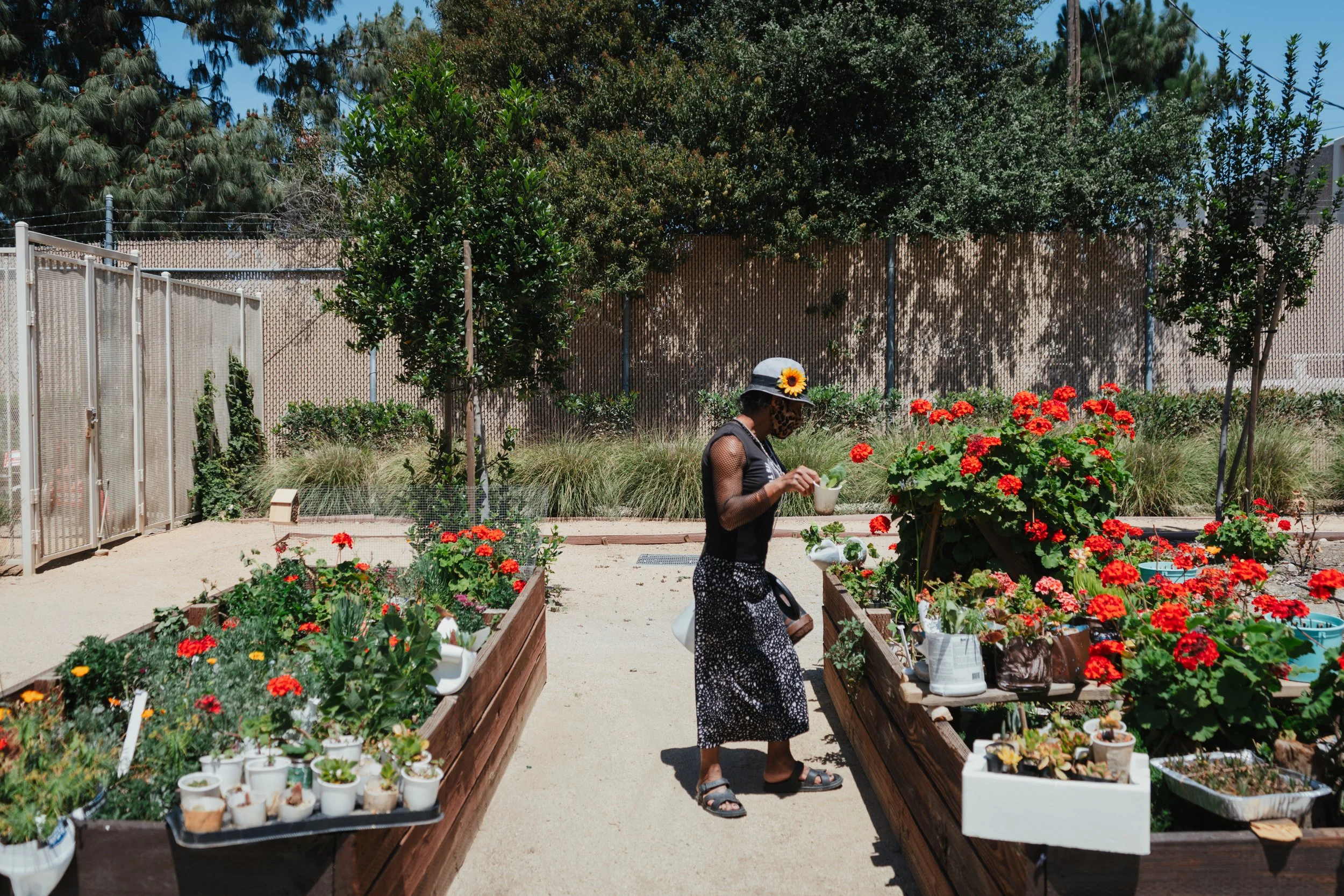
Photo by Emilio Cortez